

Creating a Bill of Quantities (BOQ) is one of the most central and challenging tasks in the construction industry. It forms the binding basis for tendering, awarding and invoicing and is decisive for the transparency, comparability and legal certainty of a project. Errors or inaccuracies have a direct impact on costs, supplements and the entire course of the project.
This article shows the technical and structural aspects of creating Bill of Quantities with NOVA AVA. The focus is on the definition and role of the Bill of Quantities, the correct structure according to VOB and GAEB as well as the content requirements for items, quantities and texts. It also explains how standardized service descriptions such as STLB Bau contribute to legal certainty and what role modern AVA software plays in the entire process.
Finally, it is shown how NOVA AVA supports the structured and efficient creation of Bill of Quantities and makes the BOQ consistently usable as a central control instrument in the AVA process.
Overview of this article
What do Bill of Quantities mean? Definition and purpose
What is a Bill of Quantities?
A Bill of Quantities (BOQ) is a detailed and binding document that describes all the services to be performed as part of a construction project. It breaks down the construction project into individual, clearly defined service items and specifies what is to be provided, in what quality, in what quantity and under what technical and legal conditions.
When creating Bill of Quantities, abstract planning content from design and implementation planning is translated into concrete, calculable individual services. The BOQ thus forms the technical and legal basis for offers, contracts and subsequent invoicing.
Role of the Bill of Quantities in construction cost management
The Bill of Quantities plays a central role in construction cost management. It is the instrument with which costs can be planned, managed and controlled. Through the structured recording of quantities and services, the BOQ enables a reliable cost calculation that is updated throughout all further project phases.
A clearly structured Bill of Quantities ensures that costs are not just estimated, but can be derived in a comprehensible manner. It thus forms the basis for cost tracking, budget control and supplement management and is closely linked to the cost structure in accordance with DIN 276.
Differentiation from the service description
Bill of Quantities and service description are often equated, but technically they are not identical terms. The service description comprises all documents that describe the services to be performed. In addition to the Bill of Quantities, this also includes plans, technical reports, preliminary remarks and special contractual conditions.
The Bill of Quantities is the quantitative and structured core of the service description. It focuses on the systematic breakdown of services into items with quantities and clear service texts. While the service description provides the content framework, the Bill of Quantities ensures the precise, billable presentation of the individual services.
Significance for tendering, awarding and invoicing
The Bill of Quantities is the central control instrument for tendering, awarding and invoicing. In the tendering process, it ensures that all bidders receive the same information basis and that their bids are based on identical performance requirements. This is the only way to ensure that bids are comparable and a fair award is possible.
In the award phase, the BOQ serves as the basis for the construction contract. In the invoicing phase, each service provided is checked and evaluated against the defined items in the Bill of Quantities. A precisely prepared BOQ reduces scope for interpretation, minimizes conflicts and creates legal certainty for all project participants.
Create Bill of Quantities according to VOB
The requirements of the German Construction Tendering and Contract Regulations (VOB) apply when drawing up the Bill of Quantities. Section 7 VOB/A in particular requires that services are described clearly and exhaustively so that all bidders understand them in the same sense and can calculate them reliably. The Bill of Quantities thus serves to implement transparency, equal treatment and competition in the award procedure.
A VOB-compliant Bill of Quantities defines the service objective, the scope of services and the execution requirements so clearly that room for interpretation is minimized. In practice, unclear or incomplete items often lead to supplements, disputes or uncertainties in invoicing.
This means for clients and planners: Only a technically correct Bill of Quantities fulfills its legal function as a basis for tendering, awarding and comprehensible, verifiable billing.
NOVA AVA supports this claim by consistently structuring the Bill of Quantities according to the VOB system. The structured recording of services, items and quantities as well as the clear separation of service description and price components make it easier for planners to create VOB-compliant Bill of Quantities and continue to use them consistently throughout the entire AVA process.
Bill of Quantities structure according to GAEB
In Germany, a professional Bill of Quantities follows the GAEB (Gemeinsamer Ausschuss Elektronik im Bauwesen) set of rules. The aim of this standardization is to clearly structure Bill of Quantities and ensure digital exchange between all project participants. When creating Bill of Quantities, the GAEB-compliant structure ensures that data can be systematically recorded, processed and evaluated.
The structure of a Bill of Quantities is hierarchical. The starting point is trades or lots, which represent the respective specialist area. Within this structure, titles and subtitles are created before the actual service items follow. This clear structure provides an overview, makes it easier to determine quantities and forms the basis for proper cost control.
The central element of the GAEB structure is the ordinal number. It ensures that each item is clearly identified and that services remain clearly assignable across tendering, awarding and invoicing. This structure is often based on the cost breakdown according to DIN 276, which creates a close link between the Bill of Quantities and construction cost management.
This structure is consistently mapped when creating Bill of Quantities with NOVA AVA. The software-supported guidance through the GAEB hierarchy helps to avoid formal errors and to create a logically structured, universally usable Bill of Quantities.
Bill of Quantities Contents – What must be included?
The technically correct content is crucial if a Bill of Quantities is to fulfill its controlling and legally compliant function. When creating Bill of Quantities, it is not only about the formal structure, but above all about the complete and clear description of all relevant service components.
The Bill of Quantities content initially includes the title page and the preliminary remarks. They define the project-specific framework, such as applicable regulations like the VOB, special contractual conditions or technical specifications. Based on this, the BOQ is divided into trades, which are clearly structured using ordinal numbers.
The service items form the core of the system. Each item describes a specific service to be performed and consists of a short text, long text, quantity and unit of measure. The long text is the legally authoritative part of the service description. It must contain all relevant information so that the service can be clearly calculated, executed and later invoiced.
The Bill of Quantities content is supplemented by the quantity determination and the price structure with unit price and total price. Precise quantity determination is one of the most important prerequisites for reliable quotations and conflict-free invoicing.
NOVA AVA supports this process by recording all content in a structured and consistent manner within the Bill of Quantities. In this way, the content of the Bill of Quantities remains traceable and controllable throughout all phases of tendering, awarding and invoicing.
Using item categories correctly in the Bill of Quantities
When creating Bill of Quantities, choosing the right item types plays an important role in correctly mapping different execution situations and uncertainties in the construction process. The VOB provides various item types for this purpose, each of which has a clearly defined function.
The standard item describes the regular service to be performed and forms the standard case in the Bill of Quantities. Basic items and additional items are used in addition to this. The basic item defines the basic service, while allowances represent additional work or special execution conditions, such as work under difficult circumstances.
Requirement items are used for services whose execution is not yet certain at the time of the invitation to tender. They may not be included in the tender evaluation, but create contractual clarity in the event that these services are required at a later date. Alternative or optional items make it possible to present different execution variants in a comparable manner without changing the basic structure of the Bill of Quantities.
The correct use of these item types increases transparency, reduces the risk of supplements and ensures a clear separation between services that have certainly been commissioned and possible additional services. NOVA AVA helps you to clearly identify the different item types and map them in a structured way in the Bill of Quantities.
Legally compliant item texts with STLB Bau
The quality of the item texts is decisive in determining whether a Bill of Quantities is clear, comparable and legally compliant. The STLB Bau (Standard Service Book for Construction Services) is therefore often used when creating Bill of Quantities – especially for public projects. It provides standardized short and long texts for almost all trades and is closely aligned with the requirements of the VOB.
STLB-Bau texts are structured in such a way that they enable a complete and product-neutral description of services. Materials, types of execution and technical requirements are clearly defined without specifying particular products or manufacturers. This significantly reduces the risk of interpretation issues, misunderstandings and subsequent supplements.
Especially for complex construction projects, the use of STLB Bau ensures a consistently high quality of service descriptions and facilitates coordination between planning, tendering and execution. When creating Bill of Quantities with NOVA AVA, STLB Bau texts can be used directly and supplemented on a project-specific basis without losing the systematics or legal certainty of the texts.
Create Bill of Quantities with AVA Software
The requirements for accuracy, traceability and timeliness make it clear that creating Bill of Quantities is hardly possible today without specialized AVA software. Manual processes are error-prone, time-consuming and make it difficult to consistently reuse data across all project phases.
AVA software supports the structured creation of Bill of Quantities according to GAEB and ensures that items, quantities and texts remain logically linked. Changes can be incorporated in a traceable manner without jeopardizing the overall structure. At the same time, digital exchange via GAEB formats is a prerequisite for smooth processes between planners, clients and contractors.
Another advantage is the consistent use of the Bill of Quantities throughout the entire AVA process. The BOQ remains the central data model from the tender to the bid evaluation and billing. This creates transparency, comparability and a reliable basis for cost control and supplementary management.
NOVA AVA consistently maps these requirements and supports the creation of Bill of Quantities as an integrated component of a continuous, digital AVA workflow.
Create Bill of Quantities with NOVA AVA
When creating Bill of Quantities with NOVA AVA, the focus is on maximally precise, structured and GAEB-compliant work. The Bill of Quantities is not seen as an isolated document, but as a central element of a continuous AVA process. The aim is to clearly describe services, minimize risks and create a reliable basis for tendering, awarding and invoicing.
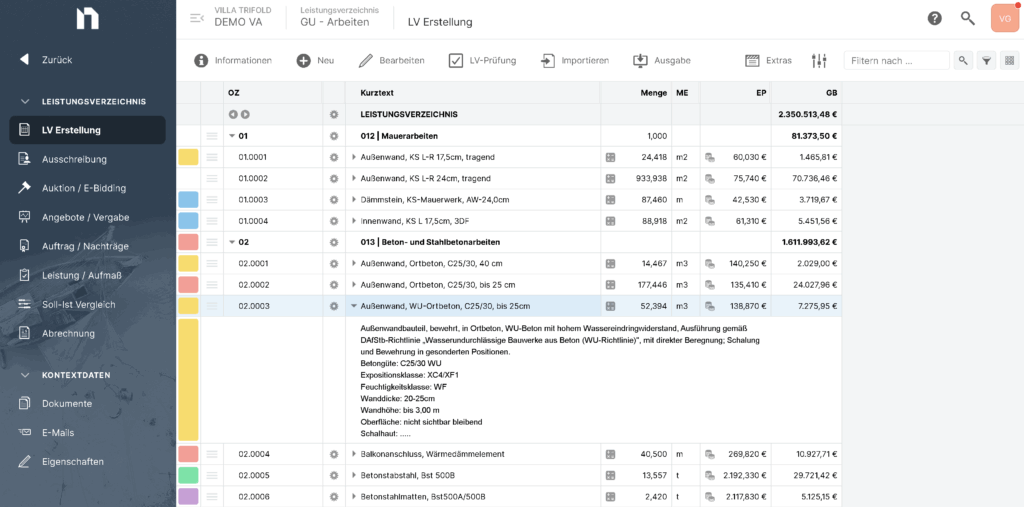
NOVA AVA supports the systematic creation of trades, titles and service items with a clear ordinal number structure. Existing Bill of Quantities can be imported via GAEB, ÖNORM A 2063 or as an Excel file and used as a template for new projects. This means that proven structures and content can be used efficiently without having to recreate every Bill of Quantities.
NOVA AVA offers the direct use of common text systems such as STLB Bau, DBD BIM, BKI or Heinze for the creation of legally compliant tender texts, provided that the corresponding accesses are available. In addition, the NOVA SmartPool provides a unique database. This enables access to millions of actually awarded service items with real market prices, completely anonymized and in compliance with data protection regulations. This means that the collective knowledge of NOVA-AVA users flows directly into BOQ creation.
Another focus is on precise quantity takeoff. NOVA AVA supports calculation approaches via an integrated formula editor based on REB 23.003. Quantities can be derived from formulas, linked together and documented with explanatory comments. Changes remain traceable and have a consistent effect on dependent items. In addition, service items can be clearly assigned to cost centers or cost units, even on a pro rata or quantity basis.
The Bill of Quantities serves as the central database in NOVA AVA. Items, texts, quantities and prices do not have to be maintained multiple times, but are available in a standardized form throughout the entire AVA process. Checking mechanisms provide support during processing and before forwarding, for example by checking quantities, units of measure and error and warning messages. Various formats are available for output, including GAEB XML, Excel and PDF, tailored to the tender, cost estimate and documentation.
With NOVA AVA, the Bill of Quantities becomes a reliable control instrument for costs, deadlines and quality in the construction project.
Bill of Quantities and tendering – interaction in the AVA process
Bill of Quantities and invitation to tender are closely linked and together form the transition from planning to awarding the contract. The Bill of Quantities defines the technical basis, while the invitation to tender describes the formal process by which suitable contractors are invited to submit bids.
A clear and complete Bill of Quantities ensures that all bidders are calculating on the same information basis. This is the only way to compare and evaluate bids objectively. Any lack of clarity in the BOQ has a direct impact on the tender and often leads to queries, price risks or offers that are difficult to compare.
In the AVA process, the Bill of Quantities remains the leading document even after the invitation to tender. It is used for the tender review, the award decision and later for invoicing the services provided. NOVA AVA supports this consistent use by continuing to use the Bill of Quantities as a central data model consistently across all phases.
Conclusion: Creating Bill of Quantities as the key to project success
A professionally prepared Bill of Quantities is much more than a formal obligation. It is the central instrument for controlling costs, quality and risks in the construction project. Only if services are clearly described, clearly structured and correctly measured can tendering, awarding and invoicing be carried out reliably and transparently.
Compliance with VOB specifications, a GAEB-compliant structure and the use of standardized service texts create the necessary technical and legal basis. In conjunction with modern AVA software, the Bill of Quantities becomes a consistent working tool that accompanies the entire course of the project.
Creating Bill of Quantities with NOVA AVA means implementing these requirements in a structured and efficient manner and using the BOQ as a reliable control instrument in the AVA process.