

In Service Phase 8, many tasks come together simultaneously: documenting defects, assigning tasks, recording meetings, coordinating plans, and tracking the construction log. The problem here isn’t the workload itself, but how the information is linked together. If you want to work efficiently in Phase 8, you don’t need yet another standalone tool—you need an integrated process.
This is precisely the approach NOVA AVA is taking with its new LP8 tools: For the first time, tickets for tasks and defects, plans, reports, and construction logs are consolidated on a single cloud platform and directly linked to work items in the BOQ. This article explains what that means in practice.
Overview of the Article’s Content
Why Traditional Defect Management in Construction Projects Often Leads to Too Much Coordination
So far, a defect is recorded in a list, and the corresponding task is sent out via email. The reference to the plan is marked somewhere else. The status appears later in a log—which may still need to be searched for. This is what defect management looks like in many projects, and it works—until it no longer does.
As soon as multiple stakeholders are involved, the effort required increases disproportionately. Information is maintained in duplicate, follow-up questions pile up, and critical interdependencies only become apparent when it’s actually already too late. The problem lies not with the people, but with the tools: Anyone who relies on scattered tools, lists, and emails is structurally building coordination overhead into the process.
Modern defect management software must therefore do more than just serve as a digital list. It must consolidate information in a centralized location—without any media discontinuities.
Defect Management in NOVA AVA: AVA and Construction Documentation Integrated for the First Time
NOVA AVA takes a different approach than traditional standalone solutions. Instead of managing defects, tasks, reports, plans, and construction logs separately, the platform brings these areas together within a single project context.
The key difference: Construction documentation is not a standalone add-on tool, but is directly integrated with the AVA processes. The new LP8 tools include:
- Tickets for Issues and Defects
- Minutes from Meetings and Site Inspections
- Plans to geolocate tickets in 2D
- Digital Construction Log
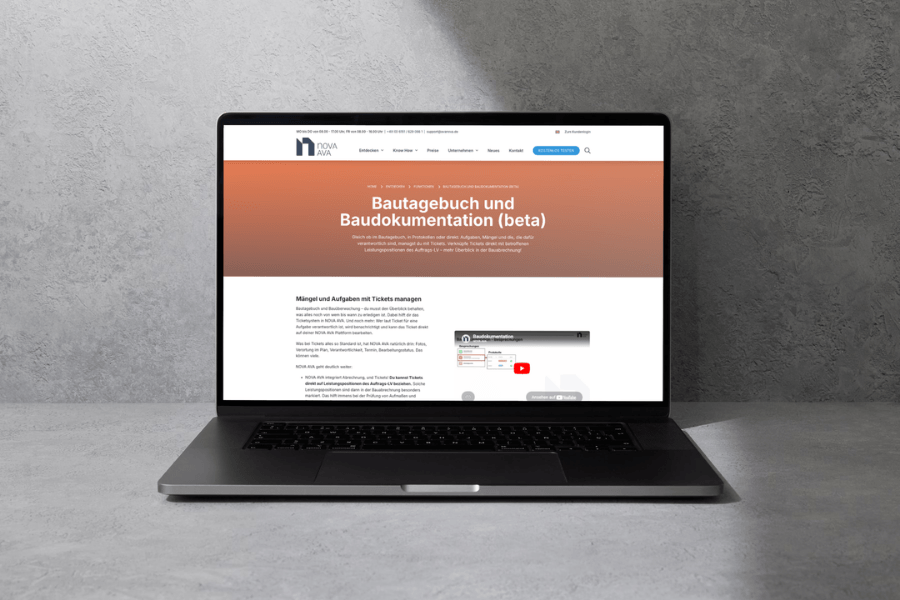
The integration with the BOQ is particularly strong: tickets can be linked directly to service items. This closes a gap that is often left open in traditional workflows—the connection between an open defect and the affected service.
How Centralized Task Management with Tickets Works
At the heart of task management is the ticket system. Tickets can be created for defects, but also for outstanding tasks identified during site inspections or points requiring coordination with stakeholders.
All tickets for a project are consolidated in a central list, where they can be filtered and sorted—and, most importantly, linked to one another. A ticket can be located on a plan so that the defect is not only described but also spatially assigned. It can be linked to a log entry that explains the background, or directly to a work item that is affected.
In this way, a single report becomes a complete task that remains visible within the overall context of the project. That is the difference between a defect list and true task management.
Defect Management Software for Construction: Why Linking It to the BOQ Is a Real Step Forward
A key advantage of NOVA AVA’s new defect management system is the direct link between tickets and work items in the BOQ. This is precisely where the capabilities of integrated defect management software in the construction industry become evident. This is because defects and tasks are no longer separate from billing but can be directly linked to the relevant service item.
This provides significant added value, particularly in construction supervision. Anyone reviewing measurements or approving work reports can immediately see whether there are any open tickets—i.e., defects—associated with a particular item. This allows for the immediate identification of work items that still have defects. This prevents the unauthorized billing of such defective work items. NOVA AVA automatically checks for this during the billing process.
For construction defect management, this means greater transparency and greater reliability in the process. The link between defects, tasks, service items, and billing creates a clear connection that is often missing in separate systems. Instead of manually gathering information, decisions can be made more quickly and with greater confidence. This is precisely what makes the integration with the BOQ a real step forward for LP8.
How integrated defect management specifically improves the construction industry in LP8
In the day-to-day work of construction supervision, the advantage of integrated processes is particularly evident when a large amount of information converges simultaneously. When defect management, task coordination, reports, plans, and the construction log are not maintained separately from one another, this significantly reduces the organizational burden. Information does not have to be entered multiple times or tracked in different places; instead, it remains together within the project context. This saves time and makes workflows much clearer.
This is especially important in LP8, because this phase involves a particularly large number of critical coordination tasks with various project stakeholders. A centralized task management system ensures that open issues are identified more quickly and that responsibilities remain clearly traceable. Instead of switching back and forth between lists, emails, meeting minutes, and status reports, a unified working framework is established. This not only improves communication but also enhances traceability within the project.
Added to this is an advantage that is often missing in traditional construction defect management: Open tickets are visible directly where they are relevant for further processing—for example, in connection with work items or when reviewing quantity surveys. This makes monitoring more structured, and important connections are less likely to be lost. It is precisely this combination of overview, documentation, and process integration that makes integrated defect management in construction in LP8 so valuable.
Construction Logs, Minutes, and Plans: How to Bring Real Order to Construction Site Documentation
Many issues and tasks don’t arise in the abstract—they stem from specific situations on the construction site, from site inspections, or from meetings. When this information then gets scattered across various documents and files, the context is lost.
In NOVA AVA, this connection is maintained. The construction log documents ongoing processes, meeting minutes record discussions and site inspections, and tickets can be directly pinned to plans. A defect is then not just a text entry, but is embedded in space and time—along with the context that is important for processing and later traceability.
This is a significant advantage, especially in projects with many participants. Anyone looking for a specific task later on—for example, as part of the warranty process—will find it right where it belongs, not buried somewhere in an email thread.
Specific improvements in the day-to-day work of planners and construction managers
Integrated defect management pays off in day-to-day operations. Here’s an overview of the key benefits for planners and construction managers:
- Less coordination effort: Information does not need to be entered multiple times or updated in different places
- Better overview: Outstanding issues become apparent more quickly, and responsibilities remain clear
- Better-structured control: Open tickets appear directly in the context of work items and quantity takeoff reviews
- Long-term traceability: Even after the construction phase is complete, processes can be quickly located—which is particularly important during the defect defense phase at the end of the warranty period
- Flexible Access: Since NOVA AVA is web-based, project information is available in the office, while working from home, and directly on the construction site
Who Can Benefit Most from This Type of Defect Management
NOVA AVA’s integrated approach is ideal for all planners working in Service Phase 8. Architectural and engineering firms that no longer wish to manage defects, tasks, and billing in separate systems will benefit directly from it.
This solution is particularly useful for teams with distributed work locations. Since NOVA AVA is web-based, all project information is accessible from a central location—whether in the office, while working from home, or directly on the construction site. No syncing, no version confusion, and no information lost along the way.
In short: Anyone who views defect management as part of an end-to-end process—rather than as an isolated task—will find that NOVA AVA provides the ideal foundation for this.
Conclusion: Defect management only becomes truly efficient when everything comes together
Defect management in LP8 is much more than just recording individual items. The key question is whether tasks, documentation, plans, reports, the construction log, and work performance truly work together in day-to-day operations—or whether each area operates independently.
NOVA AVA brings these areas together on a single platform for the first time. Linking tickets to service items closes a gap that almost always remains in traditional workflows. Outstanding issues become visible before they turn into problems—and right where the information is needed.
Try NOVA AVA now for free for 14 days and see how integrated defect management, construction logs, reports, plans, and AVA work together on a single platform.