

In many design firms, BIM has long since ceased to be a topic for the future and has become an integral part of modern project work. However, as soon as models are to serve as the basis for cost estimates, bidding, and contract awards, it quickly becomes clear that BIM software must do more than simply import IFC files. While many solutions can display models, they reach their limits when reliable quantities, standards-compliant cost structures, and efficient processing of model updates are required. This is precisely where model-based cost estimation becomes a real challenge.
Anyone who wants to use BIM cost-effectively therefore needs more than just a simple viewer or a separate add-on tool. What’s needed is BIM software that doesn’t view the model in isolation, but instead links it directly to powerful cost estimation processes. This is exactly where NOVA AVA comes in: with IFC-based model processing, BIM-supported cost planning, and an end-to-end workflow from the initial cost estimate through bidding and billing.
In short, it’s about combining a comprehensive and powerful AVA solution with equally robust BIM functionality. That’s exactly what makes NOVA AVA so strong—and it has to do with the history of NOVA AVA.
NOVA AVA was launched in 2014. Even back then—that is, right from the start—it already incorporated about 30 years of AVA expertise. How is that possible? Prior to NOVA AVA, its predecessor, ARCHITEXT—a Windows desktop solution without BIM functionality—had been available since the 1980s. So as early as 2014, NOVA AVA already incorporated the 30 years of AVA expertise gained from ARCHITEXT.
On the other hand, it was clear to the founders of NOVA AVA, Felix Grau and Sven Walter, that Building Information Modeling (BIM) would pose entirely different challenges for a software solution. The result of their thorough analysis was crystal clear. It makes no sense to extend desktop software like ARCHITEXT—which is already decades old—with BIM functionality. At best, BIM could be “somehow” tacked onto such a solution. But BIM would never become an integrated part of it that way. The decision that followed was logical, far-reaching, and groundbreaking: a completely new BIM-AVA software: NOVA AVA.
But where could NOVA AVA have acquired the necessary BIM expertise? This is where another of NOVA AVA’s strengths came into play: its close relationship with clients—highly professional clients. The opportunity presented itself. In fact, as early as the 2010s, BIM pioneers were already actively searching for a truly powerful BIM-AVA workflow. These practitioners and pioneers were (and are) more than willing to share their knowledge. What must BIM-AVA software be capable of? What do effective processes actually look like in practice? How important is it for BIM-AVA software to be able to efficiently handle updates to BIM models?
The developers at NOVA AVA absorbed, analyzed, and structured this practical know-how and turned it into powerful software. As a result, NOVA AVA became a 100% genuine cloud solution right from the start—one that requires only a web browser on the user’s end, meaning it runs on Mac, Windows, or any other operating system and does not require high-performance hardware. That’s because everything that requires computing power runs in professional, highly secure data centers—in Germany. Not least among these benefits is the efficient processing of the respective BIM model and its smooth, elegant handling in NOVA AVA’s BIM viewer.
BIM is conceived in the model, but is often held back in cost planning
Today, BIM is no longer a niche topic in the planning process. More and more projects are being designed, coordinated, and developed using models. That is precisely why expectations for BIM software are rising: The model is expected to provide a reliable basis for quantities, costs, and bidding. The model should also be helpful in construction billing.
In practice, however, a problem quickly becomes apparent. While many solutions support IFC import or model viewing, issues arise during the actual cost estimation process. Quantities must be reworked, updated models require time-consuming editing time and again, cost structures cannot be carried forward cleanly, and the transition to AVA processes remains incomplete. Instead of a seamless BIM workflow, too many manual intermediate steps arise. Too much time-consuming rework is required.
That’s why, especially in model-based projects, it’s not enough for AVA software to simply manage the model as an afterthought. If you want to work cost-effectively, transparently, and in compliance with standards, you need a solution that truly integrates BIM and cost planning—in a practical way.
Another example in this context is how BIM components and AVA information—such as scope of work and work items—are linked together. From the very beginning, NOVA AVA has had a powerful “mechanism” for recognizing BIM components and enriching them with cost and scope information (= NOVA AVA cost elements). This is achieved using the NOVA AVA filters for components. Components specify what is to be built. Cost elements specify how it is to be built and what it is expected to cost.
We can think of the NOVA AVA filters as a link between BIM components and BIM cost elements. The NOVA AVA filters identify similar BIM components based on their shared properties. This allows the components to be linked to the appropriate cost elements.
But how are these filters created? Until another flash of inspiration, the process was quite labor-intensive, even in NOVA AVA at first. You had to figure out for yourself what different types of components existed in the model and then manually combine the corresponding properties into a filter. Although NOVA AVA provided very systematic support for all of this, it was still time-consuming and not particularly pleasant.
This process was significantly improved thanks to active input from users—specifically, leading members of the BIM Alliance. They proposed a highly practical enhancement to the NOVA AVA BIM Viewer that allows users to create component filters very quickly and reliably. It was such a great idea that it was implemented in NOVA AVA exceptionally quickly—within 24 hours. The following video demonstrates exactly how this smarter method of filter creation, known as the “bouquet” method, works.
What Model-Based Cost Estimation in BIM Really Needs to Deliver
In the context of BIM, model-based cost estimation therefore means much more than simply extracting individual quantities from a 3D model. The key is that building components, quantities, costs, and work items are efficiently integrated into a consistent system. This is precisely where the true added value of powerful BIM software lies: it turns model data into a reliable foundation for cost planning and advances BIM toward 5D.
In practice, therefore, it is not enough to simply import a model or display it visually. For truly usable cost planning, quantities must be processed in a structured manner, components must be assigned in a traceable way, and they must be linked to the appropriate work items. This is precisely where many solutions reach their limits. Although they support IFC import or model viewing, they often lack the necessary depth of cost planning during the actual processing stage. Costs remain rough estimates, items are not structured in accordance with standards, and the link to the bid is incomplete.
Added to this are the typical challenges of day-to-day project work: incompletely structured models, missing classifications, and data inconsistencies between the model, cost planning, and AVA software. The result is often the same: data is manually edited, transferred to Excel, or exported to other systems. This leads to a loss of speed, transparency, and traceability, and undermines the actual benefits of BIM.
Good BIM software must therefore do more than simply display models or generate quantity takeoffs. It must ensure that model data is used to create a robust, traceable, and standards-compliant cost estimation process. This is precisely where the difference becomes apparent between a simple modeling solution and a true platform that effectively integrates BIM and cost estimation.
The NOVA AVA Approach to End-to-End BIM-Based Cost Planning
The key difference lies in the approach: NOVA AVA does not view BIM as an add-on feature, but rather as an integral part of the overall cost and bidding logic. While many solutions have added BIM as an afterthought, NOVA AVA was designed to be BIM-capable from the very beginning. This creates a seamless workflow in which the model, quantities, costs, and AVA processes interlock seamlessly.
The focus, therefore, is on IFC-based processing of the model. Components are imported in a structured manner and directly converted into usable quantities. These components and their quantities can be specifically developed into work items using cost elements and converted into standard-compliant cost structures and award units. This ensures that there is not just a loose connection between the model and costs, but rather a robust foundation for the entire project management process.
This approach is particularly evident in its end-to-end integration. From initial cost planning through the creation of Bill of Quantities documents to bidding, awarding contracts, and billing, the model remains consistently linked to costs. Changes to the model directly affect quantities and costs without requiring any manual intermediate steps.
This makes it clear: NOVA AVA is not just traditional AVA software, nor is it merely BIM software. It is a solution that bridges both worlds, providing truly practical and cost-effective BIM software.
BIM and AVA Seamlessly Integrated
At NOVA AVA, BIM is not an afterthought but is directly integrated into the AVA processes. The model, quantities, costs, and bidding are all interconnected, forming a consistent working foundation for the entire project management process.
For its model-based work, NOVA AVA uses Open BIM with IFC 3D models. These serve as the basis for quantity takeoff and are directly incorporated into cost planning. Building components can be analyzed in a structured manner, linked to cost elements, and specifically assigned to work items.
The key advantage lies in the integrated structure: From the model through cost planning to the creation of Bill of Quantities and the subsequent request for proposals, all data remains linked. Changes to the model directly affect quantities and costs without the need to manually transfer information.
This creates a transparent and traceable workflow. Quantities can be verified at any time, costs can be clearly derived, and all project participants work from a unified data set. This is precisely what ensures greater planning reliability and makes model-based cost estimation truly usable in a BIM context.
Standard-Compliant Cost Planning with BIM
Model-based cost estimation is only truly reliable if it is based on clear standards and structures that comply with industry norms. This is precisely where the combination of BIM software and AVA demonstrates its greatest strength. Quantities alone are not enough. What matters most is that they are translated into a transparent and comparable cost structure.
With NOVA AVA, cost planning is based on common standards such as DIN and ÖNORM. Components from the model are not considered in isolation, but are systematically assigned to work items with the corresponding cost groups and award units. This creates a clear link between the model, the cost structure, and the bid invitation.
This provides several key advantages in practice. Costs are derived transparently from the model, can be analyzed in a structured manner, and remain consistent throughout all project phases. At the same time, comparability between projects is improved, since all data is based on a uniform system.
Compliance with this standard is crucial, especially in complex BIM projects or in the public sector. It provides certainty in the planning process, reduces room for interpretation, and ensures that costs are not only calculated but also clearly documented and verifiable.
This makes it clear: Good BIM software doesn’t stop at the model; it ensures that the model is used to create a cost plan that complies with standards and is reliable.
Increased Efficiency for Planners and Project Teams
Model-based cost planning is not just meant to seem more digital—it’s designed to actually simplify day-to-day work. This is precisely where NOVA AVA delivers a noticeable gain in efficiency. Quantities are derived directly from the model, costs are carried forward in a structured manner, and changes are incorporated into the process without unnecessary detours. This saves time and reduces the effort required for manual rework.
This makes a big difference, especially in projects with many components and ongoing adjustments. Instead of manually checking quantities, transferring values to spreadsheets, or reconciling data across different systems, project teams work with a unified database. This speeds up cost planning and brings greater clarity to the entire process.
This approach also offers clear advantages in terms of quality. When models, quantities, and costs are consolidated into a single system, the likelihood of errors decreases significantly. Data silos are reduced, information remains traceable, and all stakeholders have access to the same up-to-date information. This not only improves internal coordination but also enhances collaboration across different project phases.
For planners, cost managers, and project teams, this means one thing above all else: fewer manual corrections, greater transparency, and greater reliability in their day-to-day work. This is exactly how BIM, in the context of cost management, becomes not only technically feasible but also truly economically viable in day-to-day project work.
Who is NOVA AVA the right BIM software for?
NOVA AVA is the ideal solution for anyone who wants to use BIM not only for model coordination, but also to derive reliable cost estimates, bid documents, and AVA processes. This is particularly relevant for architectural firms, engineering firms, and general planners who want to manage model-based projects in a cost-effective and structured manner.
This approach also offers clear advantages for public contracting authorities. When costs are planned in a transparent manner, in accordance with standards, and based on a uniform data set, comparability increases and documentation becomes significantly more organized. This is a crucial factor, especially in projects with high standards for transparency and structure.
NOVA AVA demonstrates its strengths wherever projects become more complex and traditional workflows reach their limits. This applies to building construction as well as infrastructure projects and other demanding BIM initiatives. Whenever modeling, cost planning, and tendering need to be integrated, NOVA AVA creates a seamless and practical workflow.
This means that NOVA AVA isn’t just any BIM software, but a solution for anyone who truly wants to put model-based cost estimation into practice.
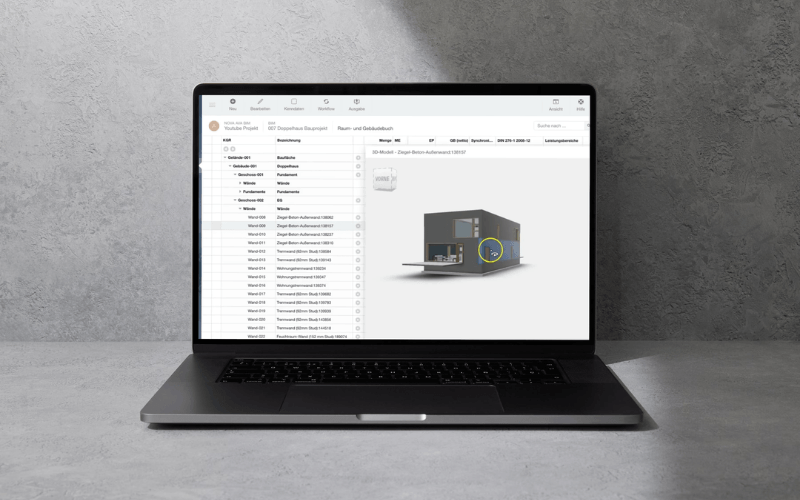
Conclusion: BIM only becomes cost-effective with end-to-end cost planning
Model-based cost estimation requires more than just an IFC import and more than just a simple model view. It is crucial that components, quantities, costs, and the bid process work together within a single, integrated system. Only then can BIM become more than just a design model—it can serve as a reliable foundation for sound business decisions.
This is precisely where NOVA AVA’s strength lies. We combine BIM software, AVA software, and standards-compliant cost planning into a single system. This results in transparent quantities, structured costs, and end-to-end processes—from initial planning through bidding to final billing.
Anyone who wants to not only visualize BIM in day-to-day project work but also use it effectively needs a solution that truly integrates the model and costs. With NOVA AVA, model-based cost estimation becomes practical, transparent, and efficient.
Experience BIM Cost Planning with NOVA AVA Firsthand
Would you like to see how model-based cost estimation with NOVA AVA works in practice? Then Try NOVA AVA now for free or schedule a demo right away. You’ll see how BIM, cost planning, and bidding can be integrated into a seamless workflow.